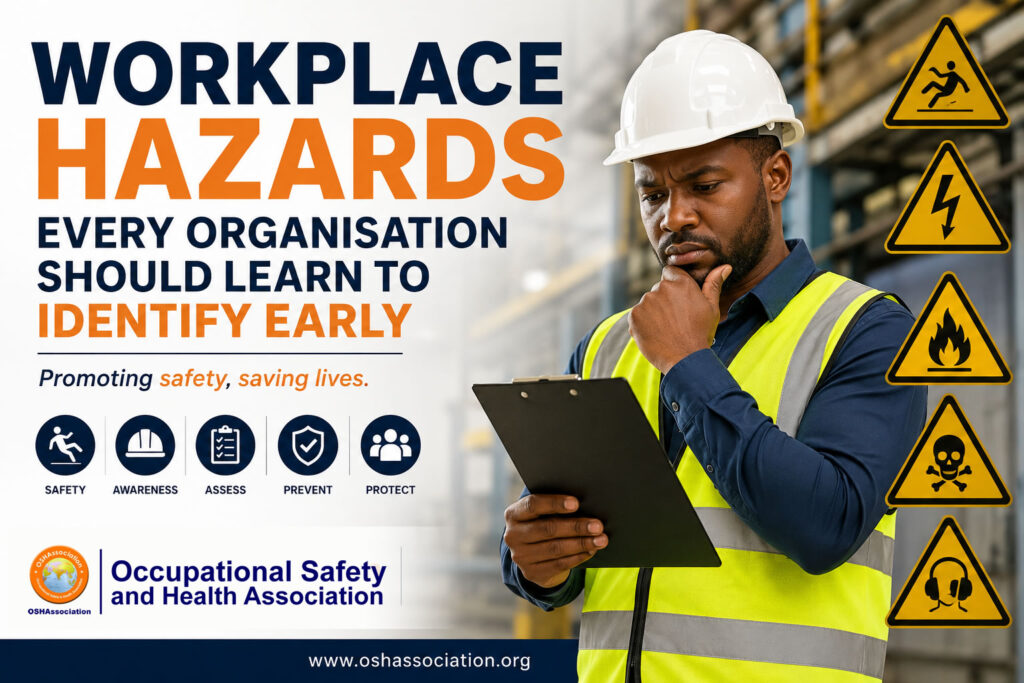
Workplace hazards are present in almost every organisation, regardless of its size or industry. From unsafe electrical equipment and slippery floors to poor ergonomics, hazardous substances and excessive workplace stress, hazards can expose employees to injuries, ill health, property damage and operational disruption.
The good news is that many workplace incidents can be prevented when hazards are identified and addressed before they cause harm.
Early hazard identification is therefore one of the most important elements of an effective occupational health and safety programme. Organisations that actively look for hazards, assess the risks they create and implement appropriate controls are better positioned to protect their employees and maintain a safer working environment.
What Is a Workplace Hazard?
A workplace hazard is anything with the potential to cause injury, ill health, damage or loss.
Hazards can come from equipment, materials, work activities, the physical environment, working conditions or even organisational practices.
Some hazards are obvious, while others may remain unnoticed until they contribute to an incident.
For example:
- A damaged electrical cable can create an electric shock or fire hazard.
- An oil spill on a walkway can cause slips and falls.
- Poor workstation design can contribute to musculoskeletal problems.
- Uncontrolled chemicals can expose workers to harmful substances.
- Excessive workloads can contribute to fatigue and reduced concentration.
- Inadequate machine guarding can expose workers to moving parts.
The ability to recognise these hazards early is essential for preventing incidents.
Why Early Hazard Identification Matters
Waiting until an accident happens before addressing a hazard is a reactive approach to safety. Effective health and safety management should instead be proactive.
Early hazard identification allows organisations to take action before workers are injured or exposed to harmful conditions.
It can help organisations to:
- Prevent workplace injuries and occupational illnesses
- Reduce the likelihood of accidents and incidents
- Protect equipment, property and the environment
- Improve employee confidence and safety awareness
- Reduce downtime and operational disruption
- Strengthen compliance with health and safety requirements
- Improve overall workplace safety performance
A strong safety culture encourages everyone in the organisation to recognise that identifying hazards is not solely the responsibility of the HSE department. Managers, supervisors, contractors and workers all have an important role to play.
Common Workplace Hazards Organisations Should Identify Early
1. Slips, Trips and Falls
Slips, trips and falls are among the most common workplace safety concerns.
Hazards may include wet floors, uneven surfaces, poorly maintained walkways, loose cables, inadequate lighting, clutter and obstructed access routes.
Organisations should routinely inspect walking and working areas and address problems as soon as they are identified.
Good housekeeping is one of the simplest and most effective ways to reduce these risks.
2. Electrical Hazards
Electricity can cause electric shock, burns, fires and fatalities when electrical systems and equipment are not properly managed.
Common warning signs include:
- Damaged cables and plugs
- Exposed electrical conductors
- Overloaded sockets
- Improper use of extension leads
- Faulty electrical equipment
- Unauthorised electrical modifications
- Electrical equipment being used in unsuitable environments
Electrical hazards should be identified and corrected by competent persons, with appropriate inspection, maintenance and safe working procedures in place.
3. Machinery and Equipment Hazards
Machines can create serious risks through moving parts, sharp edges, crushing points, rotating components and unexpected start-up.
Organisations should identify hazards associated with machinery before equipment is operated and whenever machinery, processes or working conditions change.
Appropriate guarding, maintenance, isolation procedures, training and safe operating practices can significantly reduce the risk.
4. Manual Handling and Ergonomic Hazards
Lifting, carrying, pushing and pulling can result in strains and other musculoskeletal injuries, particularly when tasks are repetitive or involve awkward postures.
Ergonomic hazards can also arise from poorly designed workstations, unsuitable seating, repetitive computer work and prolonged periods in the same position.
Organisations should assess how work is performed and consider whether tasks, equipment or workstations can be redesigned to reduce unnecessary physical strain.
5. Chemical Hazards
Chemicals may cause burns, poisoning, respiratory problems, skin conditions, fires or other forms of harm if they are not properly controlled.
Early identification should include looking at how chemicals are:
- Stored
- Labelled
- Transported
- Used
- Disposed of
Workers should also have access to relevant safety information and appropriate controls and personal protective equipment where required.
6. Fire and Explosion Hazards
Fire hazards can arise from combustible materials, faulty electrical systems, hot work, flammable substances, ignition sources and poor housekeeping.
Organisations should identify potential sources of fire and ensure that appropriate prevention and emergency arrangements are established.
Fire exits, emergency routes, alarms and firefighting equipment should also be maintained and kept accessible.
7. Working at Height
Falls from height can result in serious injuries or fatalities.
Hazards may exist when workers use ladders, scaffolds, platforms, roofs or other elevated work areas.
Before work at height begins, organisations should consider whether the task can be avoided and, where it cannot, determine how the work can be carried out safely.
Suitable access equipment, fall prevention measures, inspection and competent workers are important parts of effective control.
8. Biological Hazards
Biological hazards may include bacteria, viruses, fungi, contaminated materials and other biological agents.
They can be particularly relevant in healthcare, laboratories, food processing, waste management and certain environmental occupations.
Organisations should identify potential sources of biological exposure and implement appropriate hygiene, containment, cleaning, training and protective measures.
9. Noise and Vibration
Excessive workplace noise can contribute to hearing damage, while prolonged exposure to vibration can cause significant health problems.
The risk may be present in construction, manufacturing, engineering, transportation and other industries involving machinery and powered tools.
Early identification allows organisations to consider quieter equipment, engineering controls, maintenance, exposure limits and suitable hearing or other protective measures.
10. Psychosocial Hazards
Not all workplace hazards are physical.
Psychosocial hazards can arise from excessive workloads, long working hours, poor communication, lack of control over work, workplace conflict, bullying, harassment and other organisational factors.
These hazards can affect employee wellbeing, concentration, performance and overall workplace safety.
Organisations should create an environment where employees can raise concerns without fear and where workplace issues are identified and addressed appropriately.
How Organisations Can Improve Hazard Identification
Identifying hazards should not be a one-time exercise. It should form part of an organisation’s everyday safety management system.
Conduct Regular Workplace Inspections
Routine inspections can help identify unsafe conditions before they result in an incident.
Inspections should cover work areas, equipment, emergency routes, storage areas, electrical systems, housekeeping and other relevant hazards.
Encourage Workers to Report Hazards
Employees are often the people closest to the work and may notice hazards that are not immediately visible to management.
Organisations should provide simple and accessible ways for workers to report hazards, near misses and unsafe conditions.
Carry Out Risk Assessments
Identifying a hazard is only the first step.
Organisations should assess the risk associated with the hazard and determine appropriate control measures.
Risk assessments should also be reviewed when there are significant changes to equipment, processes, materials, personnel or working conditions.
Investigate Near Misses
A near miss is a warning that something could have gone wrong.
Instead of dismissing near misses because nobody was injured, organisations should investigate them to understand what hazards and weaknesses allowed the event to occur.
Learning from near misses can prevent future incidents.
Involve Employees in Safety
Effective hazard identification should involve the people who perform the work.
Employees can provide valuable information about unsafe conditions, difficult tasks and practical challenges that may not be obvious during a management inspection.
Provide Appropriate Training
Workers need to understand the hazards associated with their jobs and how to control them.
Regular health and safety training can improve hazard awareness and help employees recognise unsafe conditions before they result in harm.
Use the Hierarchy of Controls
Once a hazard has been identified, organisations should consider how best to control it.
The hierarchy of controls provides a structured approach:
- Elimination – Remove the hazard completely where possible.
- Substitution – Replace the hazard with a safer alternative.
- Engineering controls – Separate people from the hazard through physical controls.
- Administrative controls – Change the way work is organised or performed through procedures, training and supervision.
- Personal protective equipment (PPE) – Protect workers with appropriate protective equipment where risks remain.
PPE is important, but it should not automatically be the first or only control considered. Organisations should seek to eliminate or reduce hazards at their source wherever reasonably practicable.
Hazard Identification Is Everyone’s Responsibility
A strong workplace safety culture develops when employees understand that safety is a shared responsibility.
Management must provide leadership, resources and appropriate systems. Supervisors must monitor work activities and address unsafe conditions. Workers must follow safe working procedures and report hazards. HSE professionals must support the organisation through competent advice, monitoring and continuous improvement.
When everyone participates, hazards are more likely to be identified before they become incidents.
Conclusion
Workplace accidents rarely happen without warning. Unsafe conditions, hazardous behaviours, inadequate controls and other warning signs may exist long before an incident occurs.
The organisations that achieve better safety performance are those that learn to recognise these warning signs early and take action.
Regular inspections, effective risk assessments, employee involvement, hazard reporting, training and continuous monitoring can help organisations move from a reactive approach to a proactive safety culture.
Identifying a hazard early can make the difference between a simple corrective action and a serious workplace incident.
Every organisation should therefore make early hazard identification an essential part of its occupational health and safety management system.
Build a Stronger Safety Culture with OSHAssociation
Effective workplace safety begins with knowledge, competence and a commitment to continuous improvement.
At OSHAssociation, we support organisations and professionals in developing their occupational safety and health knowledge through professional training, certification and membership.
Promoting safety, saving lives.
Visit www.oshassociation.org to learn more about OSHAssociation training, professional membership and safety resources.