World Humanitarian Day – 19 August 2026
Every day, humanitarian workers step forward in some of the world’s most challenging and dangerous environments to help people affected by conflict, disasters, displacement, disease and other crises.
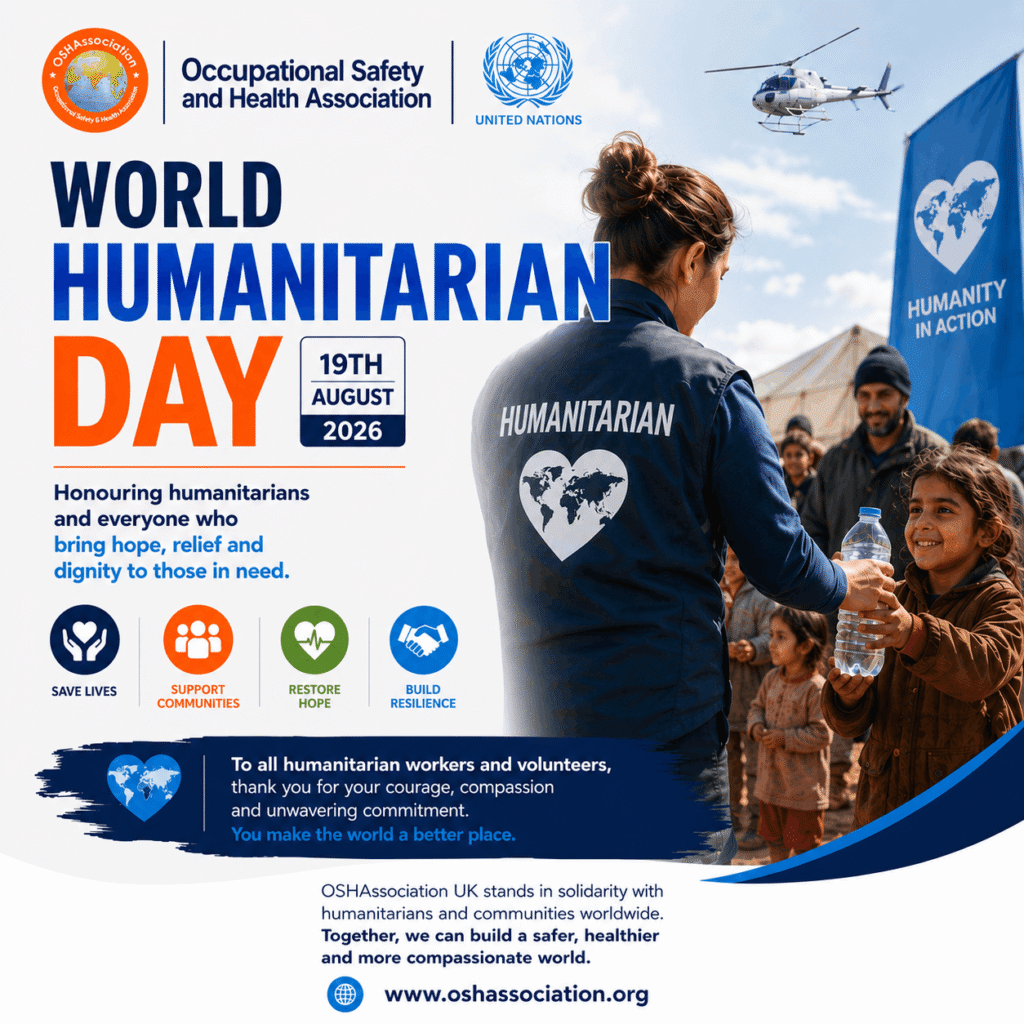
On 19 August 2026, World Humanitarian Day provides an opportunity to recognise their courage, compassion and commitment, while also drawing attention to the need to protect humanitarian workers and the communities they serve.
For OSHAssociation UK, this day carries a particularly important message: protecting people must always remain at the heart of everything we do.
What Is World Humanitarian Day?
World Humanitarian Day is observed every year on 19 August to honour humanitarian workers and stand in solidarity with people affected by crises around the world. The United Nations recognises the day as an opportunity to advocate for the survival, well-being and dignity of people affected by emergencies, as well as the safety and security of humanitarian personnel.
The date also carries a solemn history.
On 19 August 2003, a bombing at the Canal Hotel in Baghdad, Iraq, killed 22 people, including humanitarian personnel working with the United Nations. Five years later, the UN General Assembly adopted Resolution 63/139, establishing 19 August as World Humanitarian Day. The first observance took place in 2009.
Today, the day serves both as a tribute to those who have lost their lives in humanitarian service and as a global call to protect those continuing this vital work.
Humanitarian Workers Are Lifelines
When a crisis occurs, humanitarian workers are often among the first people to respond.
They may provide:
- Emergency medical care
- Food and clean water
- Shelter and essential supplies
- Protection and support for vulnerable people
- Sanitation and hygiene services
- Emergency education and community support
- Assistance to displaced families
- Support for communities recovering from disasters
Their work can take place in conflict zones, refugee camps, disaster-affected communities, remote locations and areas where basic infrastructure has been severely damaged.
Behind every humanitarian response are people making difficult decisions, travelling into challenging environments and working under significant physical and psychological pressures.
Their work saves lives.
The Safety of Humanitarian Workers Matters
Humanitarian workers dedicate themselves to helping others, but their own safety must never be overlooked.
The United Nations has highlighted the continuing threats faced by humanitarian personnel, including killings, injuries, abductions, detention and obstruction while carrying out their duties. It has also emphasised the importance of appropriate equipment, security training and mental health and psychosocial support for humanitarian personnel.
This is where occupational safety and health has an important role to play.
A humanitarian organisation cannot effectively protect vulnerable communities if the people delivering assistance are themselves exposed to preventable risks.
Effective safety management can help humanitarian organisations identify hazards, assess risks, establish emergency procedures, provide appropriate personal protective equipment, train personnel and develop systems that enable workers to operate as safely as possible.
The people who save lives must also be protected.
Safety in Humanitarian Operations
Humanitarian operations can expose workers to a wide range of hazards.
Depending on the environment, these may include:
Physical hazards
Humanitarian personnel may work around damaged buildings, unstable structures, debris, vehicles, machinery, electrical hazards, fire risks and unsafe infrastructure.
Biological hazards
Outbreaks of infectious diseases, contaminated water, poor sanitation and exposure to biological agents can create significant risks for humanitarian workers and affected communities.
Environmental hazards
Extreme heat, flooding, storms, earthquakes, poor air quality and other environmental conditions can make emergency operations particularly challenging.
Security risks
Workers operating in areas affected by armed conflict, civil unrest or other security threats may face serious risks to their personal safety.
Psychological risks
Repeated exposure to suffering, death, displacement, violence and traumatic events can place considerable psychological pressure on humanitarian personnel.
These risks demonstrate why safety cannot be treated as an afterthought. It must be integrated into humanitarian planning, training and operations from the beginning.
Protecting Those Who Protect Others
Humanitarian principles are built around humanity, impartiality, neutrality and independence. Humanitarian workers must be able to reach people in need and provide assistance based on need.
But humanitarian access and humanitarian safety are closely connected.
When aid workers are attacked, threatened or prevented from reaching communities, the consequences extend far beyond the individual worker. Essential services can be interrupted, food and medical supplies may not reach people who need them, and already vulnerable communities can become even more exposed to harm.
Protecting humanitarian personnel therefore helps protect the wider humanitarian response.
It also reinforces a fundamental principle shared by both humanitarian action and occupational safety:
Every life matters.
The Importance of Training and Preparedness
Preparation can make a significant difference when people are required to operate in emergency environments.
Humanitarian organisations should ensure that personnel understand the hazards associated with their assignments and receive appropriate training before deployment.
Depending on the nature of the work, this may include:
- Emergency preparedness and response
- Risk assessment
- First aid
- Fire safety
- Personal protective equipment
- Manual handling
- Electrical safety
- Infection prevention and control
- Working in extreme environmental conditions
- Security awareness
- Safe driving and vehicle safety
- Psychological health and wellbeing
- Emergency communication procedures
Training alone cannot eliminate every risk, but competent and well-prepared personnel are better equipped to recognise hazards, make informed decisions and respond effectively when circumstances change.
A Shared Responsibility to Protect Life
World Humanitarian Day is not only an opportunity to thank humanitarian workers. It is also a reminder that protecting human life requires collective responsibility.
Governments, humanitarian organisations, employers, communities and individuals all have a role to play in creating environments where people can work safely and where those affected by crises can receive assistance with dignity.
The United Nations’ 2026 campaign places renewed emphasis on moving beyond concern towards meaningful action and accountability, including protecting humanitarian and medical personnel and enabling safe humanitarian access.
For organisations involved in humanitarian work, this means putting safety into practice through effective policies, competent personnel, risk management and a strong safety culture.
OSHAssociation UK: Promoting Safety, Saving Lives
At OSHAssociation UK, we believe that safety is fundamental to the protection of human life.
Our mission to promote safety and support better occupational health and safety practices reflects a principle that is especially relevant on World Humanitarian Day: those who work to protect and improve the lives of others deserve protection too.
From emergency responders and healthcare workers to aid workers, volunteers and community support personnel, humanitarian workers make an extraordinary contribution to communities around the world.
Their courage should be recognised.
Their safety should be prioritised.
Their work should be supported.
A Message of Appreciation
On this World Humanitarian Day, we honour every humanitarian worker and volunteer who continues to serve others in difficult circumstances.
We remember those who have lost their lives while carrying out humanitarian work.
We stand with communities affected by conflict, disasters and other crises.
And we recognise the countless individuals whose compassion, courage and commitment bring hope to people when they need it most.
To every humanitarian worker and volunteer: thank you for serving humanity.
Your work saves lives.
Your courage brings hope.
Your commitment makes a difference.
At OSHAssociation UK, we stand in solidarity with humanitarian workers and communities worldwide.
Together, we can build a safer, healthier and more compassionate world.