In many workplaces, accidents are often treated as the most important warning signs of safety failure. However, there is another type of event that can provide equally valuable—sometimes even more valuable—lessons: the near miss.
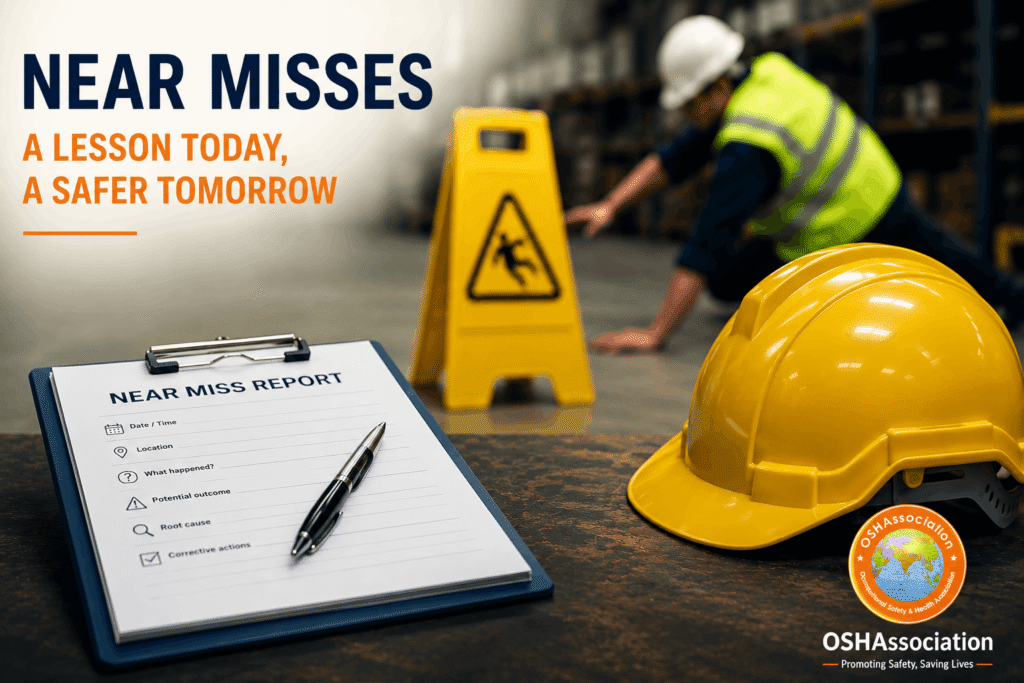
A near miss is an unplanned event that could have resulted in injury, illness, property damage, environmental harm, or other loss, but did not. Perhaps a worker narrowly avoided being struck by a falling object. Maybe a forklift came dangerously close to a pedestrian. A machine malfunctioned but no one was injured. Or an employee slipped but managed to regain their balance before falling.
In each of these situations, the outcome may appear positive because no one was harmed.
However, the event itself is a warning.
A near miss is an opportunity for an organisation to identify hazards, correct weaknesses, and prevent a future incident from becoming a serious accident.
A Near Miss Is Not “Nothing Happened”
One of the biggest mistakes organisations make is dismissing near misses because there was no injury or damage.
Statements such as:
- “Nobody was hurt.”
- “It was just a close call.”
- “The worker was lucky.”
- “There is no need to report it.”
can prevent organisations from learning important lessons.
The fact that nobody was injured does not mean that the workplace was safe. It may simply mean that the circumstances happened to produce a favourable outcome on that particular occasion.
The same hazard may exist tomorrow.
The next time, the outcome could be very different.
This is why near misses should be treated as early warning signals. They give organisations an opportunity to intervene before the consequences become more serious.
Near Misses Reveal Hidden Weaknesses
A near miss often exposes weaknesses that may otherwise remain unnoticed.
For example, a worker may nearly fall because:
- a walkway is poorly maintained;
- a spill was not cleaned promptly;
- lighting was inadequate;
- the worker was rushing;
- housekeeping standards were poor;
- there was no effective inspection process.
The immediate event may appear to be a simple slip. However, a proper investigation may reveal several underlying failures.
This is one of the most important lessons from near-miss reporting:
The visible event is not always the real cause of the problem.
Organisations that investigate only the immediate action may miss the deeper issues within their systems, procedures, supervision, training, or workplace design.
Near Misses Help Identify Trends Before Accidents Occur
A single near miss may appear to be an isolated event. However, multiple near misses can reveal a pattern.
For example, an organisation may record:
- several near collisions between vehicles and pedestrians;
- repeated reports of damaged electrical cables;
- multiple instances of workers nearly falling from the same area;
- repeated equipment failures;
- frequent manual handling near misses.
Individually, each event may seem minor.
Collectively, they may indicate a serious and recurring risk.
This is why organisations should not only record near misses but also analyse them for trends.
Questions worth asking include:
- Are the same hazards appearing repeatedly?
- Are incidents occurring in the same location?
- Are particular tasks involved?
- Are specific shifts or work patterns associated with the events?
- Are certain types of equipment involved?
- Are the same underlying causes being repeated?
Trend analysis allows organisations to move from simply reacting to events to proactively managing risk.
A Strong Near-Miss Reporting Culture Improves Safety Awareness
Employees are often the people closest to workplace hazards. They see unsafe conditions, equipment problems, process weaknesses, and risky behaviours as part of their daily work.
When workers are encouraged to report near misses, organisations gain access to valuable safety information.
However, employees are unlikely to report near misses if they believe they will be:
- blamed;
- punished;
- embarrassed;
- ignored;
- criticised for making a mistake.
A positive safety culture encourages workers to report hazards and near misses without fear of unfair punishment.
This does not mean that organisations should ignore deliberate or reckless behaviour. It means that the focus should be on understanding what happened and why.
A good reporting culture asks:
“What can we learn from this?”
rather than immediately asking:
“Who should we blame?”
Near-Miss Investigations Should Focus on Learning
A near-miss investigation should not simply be a paperwork exercise.
The objective should be to understand the event and identify appropriate corrective actions.
A useful investigation may consider:
1. What happened?
The organisation should establish the facts of the event.
What was the worker doing? What equipment was involved? Where did it happen? What happened immediately before the near miss?
2. What could have happened?
Understanding the potential consequence is important.
Could the event have resulted in:
- a serious injury?
- a fatality?
- significant property damage?
- environmental harm?
- business interruption?
The fact that the outcome was minor does not mean the risk was minor.
3. Why did it happen?
The investigation should explore the contributing factors.
These may include:
- inadequate risk assessment;
- insufficient training;
- poor supervision;
- equipment failure;
- ineffective procedures;
- poor communication;
- inadequate maintenance;
- fatigue or workload;
- poor workplace design.
4. What needs to change?
The investigation should lead to practical action.
This could involve:
- eliminating the hazard;
- improving engineering controls;
- changing a work process;
- improving training;
- revising a procedure;
- increasing supervision;
- improving inspection and maintenance;
- providing suitable personal protective equipment.
The goal is not simply to record the near miss.
The goal is to reduce the likelihood of recurrence.
Organisations Must Avoid the Blame Trap
One of the most common weaknesses in incident investigations is focusing too quickly on individual behaviour.
For example, if a worker nearly falls, the investigation may conclude:
“The employee was careless.”
But this may not be the complete story.
Why was the worker rushing?
Was the workload excessive?
Was the work area poorly designed?
Was the worker properly trained?
Was the procedure practical?
Was supervision adequate?
Was the correct equipment available?
A person may have made an error, but the error may have occurred within a system that made the error more likely.
Effective safety management looks beyond individual actions and examines the wider system.
Near-Miss Reporting Can Strengthen Risk Assessments
Risk assessments should not remain static documents that are completed once and forgotten.
Near-miss incidents provide real-world information that can help organisations review and improve their risk assessments.
A near miss may reveal that:
- a hazard was not previously identified;
- the likelihood of an event was underestimated;
- existing control measures were ineffective;
- workers were not following the procedure because it was impractical;
- conditions had changed since the original assessment.
When this happens, the risk assessment should be reviewed.
The organisation should ask:
“What does this event tell us about the effectiveness of our existing controls?”
This question can lead to meaningful improvements.
Effective Corrective Actions Go Beyond “Retrain the Worker”
Training is important, but it should not automatically be the first or only corrective action.
If a worker nearly falls because a damaged platform was not repaired, simply providing additional training may not address the real problem.
A stronger response may include:
- repairing or replacing the platform;
- improving inspection arrangements;
- introducing a formal defect-reporting system;
- preventing access to unsafe areas;
- improving maintenance controls.
Training may still be necessary, but it should form part of a broader solution when appropriate.
The most effective corrective action is one that addresses the underlying cause of the near miss.
Near Misses Can Demonstrate the Value of Prevention
Many organisations only recognise the importance of safety after an accident has occurred.
By then, the organisation may face:
- injuries and human suffering;
- loss of productivity;
- damaged equipment;
- legal consequences;
- compensation costs;
- reputational damage;
- reduced employee morale.
Near misses provide an opportunity to act before these consequences occur.
Investing in corrective action after a near miss may prevent a much more expensive and serious incident in the future.
Prevention is not simply a compliance responsibility. It is also a sound business decision.
Every Employee Has a Role to Play
Near-miss reporting should not be the responsibility of the safety department alone.
Everyone in the organisation has a role to play.
Workers should:
- report hazards and near misses promptly;
- follow safe working procedures;
- participate in investigations where appropriate;
- raise concerns when controls are ineffective.
Supervisors should:
- take reports seriously;
- respond quickly to identified hazards;
- ensure corrective actions are implemented;
- communicate lessons learned to their teams.
Managers should:
- provide adequate resources;
- support reporting systems;
- monitor recurring trends;
- ensure safety improvements are implemented.
Senior leadership should:
- demonstrate visible commitment to safety;
- promote a positive reporting culture;
- ensure safety is integrated into business decisions;
- measure prevention, not only accident statistics.
A strong safety culture exists when people understand that reporting a near miss is not creating a problem—it is helping to prevent one.
The Goal Is Not More Reports—It Is Fewer Risks
It is important to understand that a successful near-miss programme is not measured simply by the number of reports received.
An organisation that suddenly receives more near-miss reports may actually be improving its safety culture because employees are becoming more willing to report.
The more important questions are:
- Are hazards being corrected?
- Are recurring events reducing?
- Are investigations identifying underlying causes?
- Are employees receiving feedback?
- Are risk controls becoming more effective?
The ultimate goal is not to create paperwork.
The goal is to create learning and reduce risk.
Turning Near Misses Into Organisational Learning
A near miss becomes valuable when the organisation learns from it and shares the lesson.
For example, if a worker nearly falls because of an unprotected opening, the lesson should not remain limited to the individuals involved.
The organisation should consider whether similar hazards exist elsewhere.
The lesson may need to be communicated through:
- toolbox talks;
- safety meetings;
- safety alerts;
- updated procedures;
- refresher training;
- management reviews.
An important question is:
“Could this happen somewhere else in our organisation?”
If the answer is yes, the organisation should take action before the same event occurs again.
Conclusion: A Near Miss Is a Second Chance
Every near miss represents a moment when something could have gone seriously wrong—but did not.
That moment should not be wasted.
Organisations that take near misses seriously can identify weaknesses before they lead to injury, damage, or loss. They can improve risk assessments, strengthen controls, improve safety awareness, and build a more proactive safety culture.
The most important lesson is simple:
A near miss is not an event to ignore. It is an opportunity to prevent the next accident.
Every organisation should therefore encourage the reporting of near misses, investigate them properly, identify underlying causes, and take meaningful corrective action.
Because the difference between a near miss and a serious accident is sometimes nothing more than timing, circumstances, or luck.
Do not wait for someone to be injured before learning the lesson.
A safer workplace begins with recognising the warning signs—and taking action.
About OSHAssociation
The Occupational Safety and Health Association (OSHAssociation) is an international professional membership and certification organisation dedicated to promoting safety across all industries worldwide. Through a global network of Authorised Training Providers, OSHAssociation supports the delivery of quality health and safety education while awarding internationally recognised certifications and providing professional membership for individuals committed to advancing workplace safety.
Promoting Safety. Saving Lives.
For organisations and professionals seeking to strengthen their knowledge and commitment to workplace safety, learn more about OSHAssociation’s professional programmes and membership opportunities through the official OSHAssociation website.