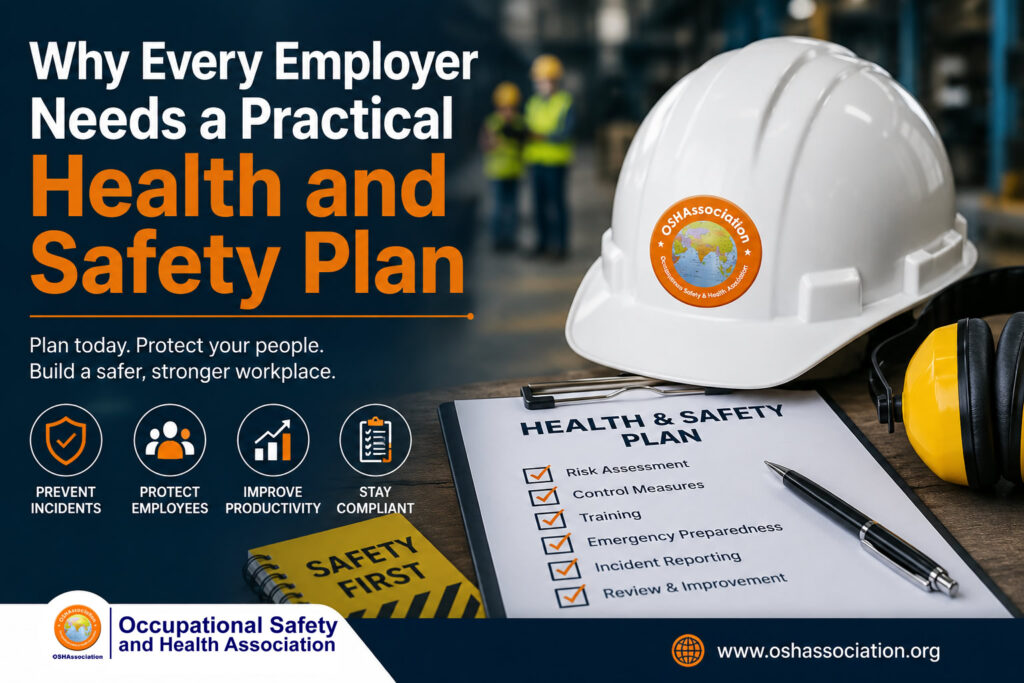
A practical health and safety plan is more than a compliance document. It is a vital tool for protecting employees, reducing workplace risks, improving productivity and building a stronger safety culture.
Every workplace, regardless of its size or industry, faces health and safety risks. From slips, trips and manual handling injuries to machinery hazards, electrical risks, hazardous substances and workplace stress, seemingly ordinary activities can result in serious incidents when risks are not properly managed.
For employers, the question should not simply be “Are we complying with health and safety requirements?” It should be:
“Do we have a practical health and safety plan that actually works in our workplace?”
A well-developed health and safety plan provides a structured approach to identifying hazards, assessing risks, implementing controls and ensuring that everyone understands their responsibilities.
What Is a Workplace Health and Safety Plan?
A workplace health and safety plan is a documented framework that explains how an organisation will identify, control and manage occupational health and safety risks.
It should reflect the actual activities, working environment, workforce and risks of the organisation rather than being a generic document created simply to satisfy a requirement.
An effective plan typically addresses areas such as:
- Hazard identification and risk assessment
- Safe systems of work
- Emergency preparedness and response
- Personal protective equipment (PPE)
- Workplace inspections
- Incident and near-miss reporting
- Employee health and safety training
- Fire safety
- First aid arrangements
- Equipment and machinery safety
- Chemical and hazardous substance management
- Manual handling
- Contractor and visitor safety
- Health surveillance where applicable
- Monitoring, review and continuous improvement
The exact contents will depend on the organisation’s industry and activities, but the objective remains the same: prevent harm and create a safer working environment.
1. It Helps Employers Identify Hazards Before They Cause Harm
One of the most important functions of a health and safety plan is to encourage proactive risk management.
Rather than waiting for an accident to happen, employers can identify potential hazards and determine appropriate control measures in advance.
For example, a workplace risk assessment may identify:
- Wet or uneven floors
- Exposed electrical hazards
- Unguarded machinery
- Working at height
- Poor manual handling practices
- Inadequate ventilation
- Hazardous chemicals
- Fire hazards
- Excessive workplace noise
- Poor housekeeping
Once hazards have been identified, employers can evaluate the associated risks and determine how those risks should be controlled.
This proactive approach can significantly reduce the likelihood of workplace accidents, injuries and occupational ill health.
2. It Creates Clear Health and Safety Responsibilities
Health and safety should not be the responsibility of one person alone.
Managers, supervisors, employees, contractors and other workplace stakeholders all have roles to play in maintaining a safe working environment.
A practical health and safety plan clearly establishes who is responsible for:
- Conducting and reviewing risk assessments
- Providing employee training
- Maintaining equipment
- Reporting and investigating incidents
- Carrying out workplace inspections
- Managing emergencies
- Providing appropriate PPE
- Monitoring health and safety performance
When responsibilities are clearly defined, it becomes easier to identify gaps and ensure that important safety tasks are not overlooked.
3. It Supports Employee Health and Safety Training
Even the best safety procedures will have limited value if employees do not understand them.
Training is therefore an essential part of an effective health and safety plan.
Employees should receive appropriate information, instruction and training based on the hazards associated with their work.
Depending on the workplace, this may include training in:
- Risk assessment
- Fire safety
- First aid
- Manual handling
- Personal protective equipment
- Working at height
- Electrical safety
- Hazardous substances
- Emergency procedures
- Incident reporting
- Occupational health and safety awareness
Employers should also recognise that health and safety training is not necessarily a one-time activity. Refresher training and additional instruction may be required when processes, equipment, legislation or workplace risks change.
For organisations looking to strengthen their employees’ professional health and safety competence, appropriate training and internationally recognised certification can form an important part of the overall safety strategy.
4. It Helps Reduce Workplace Accidents and Injuries
A strong health and safety plan focuses on preventing incidents rather than simply responding to them.
When hazards are systematically identified and controlled, the organisation can reduce exposure to unnecessary risks.
This can help prevent incidents such as:
- Slips and trips
- Falls from height
- Cuts and crushing injuries
- Machinery-related accidents
- Manual handling injuries
- Electrical incidents
- Chemical exposure
- Fires and explosions
- Vehicle-related incidents
However, prevention does not mean assuming that incidents will never happen.
A good plan should also explain what employees should do when an incident, near miss or unsafe condition occurs.
5. It Improves Emergency Preparedness
Emergencies can happen with little warning.
A fire, chemical spill, serious injury, equipment failure or other emergency can quickly become more serious when employees do not know how to respond.
A practical health and safety plan should therefore include appropriate emergency arrangements.
These may cover:
- Emergency evacuation procedures
- Fire emergency arrangements
- First aid provision
- Emergency contact information
- Assembly points
- Reporting procedures
- Communication arrangements
- Roles and responsibilities during emergencies
- Procedures for specific workplace hazards
Emergency procedures should not simply exist on paper. Employees should understand them, and appropriate drills or exercises should be conducted where necessary.
6. It Strengthens Workplace Safety Culture
A safety culture develops from the behaviours, attitudes and decisions that an organisation demonstrates every day.
If management treats health and safety as a paperwork exercise, employees may do the same.
However, when leadership actively demonstrates that safety is a priority, employees are more likely to take safety responsibilities seriously.
A practical health and safety plan can support this culture by encouraging:
- Open reporting of hazards and near misses
- Employee participation
- Regular safety meetings
- Workplace inspections
- Management involvement
- Continuous training
- Learning from incidents
- Continuous improvement
Importantly, employees should feel comfortable reporting hazards and unsafe conditions without fear of unfair treatment.
7. It Can Improve Productivity and Business Performance
Health and safety is sometimes viewed as an expense rather than an investment.
However, workplace accidents and occupational ill health can create significant direct and indirect costs for an organisation.
These may include:
- Medical and compensation costs
- Equipment damage
- Production delays
- Employee absence
- Investigation costs
- Recruitment and replacement costs
- Loss of productivity
- Damage to reputation
- Disruption to operations
A safer workplace can help organisations maintain more consistent operations and reduce avoidable disruptions.
When employees know how to perform their tasks safely and efficiently, health and safety can become part of overall operational excellence rather than an obstacle to productivity.
8. It Helps Demonstrate Due Diligence and Compliance
Health and safety responsibilities vary according to the country, industry and nature of the organisation.
Employers must understand and comply with the occupational health and safety requirements applicable to their operations.
A documented health and safety plan can help demonstrate that the organisation has taken a structured approach to managing workplace risks.
However, documentation alone is not enough.
A policy or plan that sits in a filing cabinet but is not implemented, communicated or reviewed does little to protect workers.
The real value comes from putting the plan into practice.
9. It Provides a Framework for Incident Reporting and Learning
An incident should not simply be recorded and forgotten.
Every accident, near miss and dangerous occurrence can provide an opportunity to identify weaknesses in existing controls.
A good health and safety plan should establish a process for:
- Reporting the incident.
- Making the area safe.
- Providing appropriate assistance.
- Investigating what happened.
- Identifying immediate and underlying causes.
- Implementing corrective actions.
- Monitoring whether those actions are effective.
- Sharing relevant lessons with employees.
This approach allows organisations to learn from incidents and reduce the likelihood of similar events happening again.
10. It Encourages Continuous Improvement
Workplaces are constantly changing.
New equipment may be introduced. Employees may change roles. Production processes may be modified. New substances may be used. Contractors may arrive on site. Legislation and industry expectations may also change.
For these reasons, a health and safety plan should never be considered a finished document.
Employers should regularly review:
- Risk assessments
- Safety procedures
- Training requirements
- Incident statistics
- Near-miss reports
- Inspection findings
- Emergency arrangements
- Employee feedback
- Corrective actions
The goal should be continuous improvement.
What Should a Practical Health and Safety Plan Include?
Although every organisation should develop its plan around its own risks, a practical workplace health and safety plan should generally include:
Health and Safety Policy
A clear statement of the organisation’s commitment to protecting employees and others affected by its activities.
Hazard Identification and Risk Assessment
A systematic process for identifying hazards, evaluating risks and determining appropriate control measures.
Roles and Responsibilities
Clearly defined responsibilities for management, supervisors, employees and other relevant parties.
Safe Working Procedures
Practical instructions for carrying out higher-risk tasks safely.
Training and Competence
Requirements for induction, job-specific training, refresher training and competency assessment.
Emergency Procedures
Clear arrangements for responding to foreseeable emergencies.
Incident and Near-Miss Reporting
A process for reporting, investigating and learning from workplace incidents.
Workplace Inspections
Regular checks to identify unsafe conditions and verify that controls remain effective.
Monitoring and Review
Methods for measuring performance and improving the organisation’s health and safety management system.
How Employers Can Make Their Safety Plan Practical
The most effective safety plans are not necessarily the longest.
A practical plan should be:
Clear
Employees should be able to understand what is expected of them without unnecessary technical language.
Relevant
The plan should address the actual hazards associated with the organisation’s activities.
Accessible
Employees should know where to find safety procedures, emergency information and other relevant resources.
Implemented
Procedures should be actively used rather than simply documented.
Reviewed
The plan should be reviewed whenever significant changes occur and at appropriate intervals.
Supported by Training
Employees need the knowledge and competence required to implement the plan effectively.
Health and Safety Is Everyone’s Responsibility
Although employers have an important duty to provide a safe working environment, effective workplace safety requires participation from everyone.
Management must provide leadership and resources.
Supervisors must implement procedures and monitor work activities.
Employees must follow safe working practices and report hazards.
Health and safety professionals must provide appropriate expertise and guidance.
When these responsibilities work together, organisations can create a stronger and more sustainable safety culture.
The Role of Professional Health and Safety Training
A practical health and safety plan is only as effective as the people responsible for implementing it.
Employers should therefore consider investing in structured occupational health and safety training for employees, supervisors, managers and safety professionals.
Professional training can help individuals develop the knowledge and practical skills required to identify hazards, assess risks, implement control measures and contribute to effective safety management.
At OSHAssociation, we are committed to promoting safety, saving lives by supporting health and safety education, professional development and internationally recognised certification.
Whether you are an employer seeking to strengthen workplace safety, an individual looking to develop your health and safety career, or an organisation interested in professional training and certification, building competence is an important step towards creating safer workplaces.
Final Thoughts
Every employer needs more than a health and safety policy sitting in a document folder.
They need a practical health and safety plan that is understood, implemented, monitored and continuously improved.
A strong plan helps organisations identify hazards before they cause harm, prepare for emergencies, support employee training, reduce workplace incidents and build a positive safety culture.
Most importantly, effective health and safety management protects what matters most: people.
A safer workplace is not created by paperwork alone. It is created through leadership, competence, communication, employee involvement and consistent action.
Invest in workplace safety today — because preventing harm is always better than responding to it afterwards.
Build Your Health and Safety Knowledge with OSHAssociation
If you are looking to improve your professional health and safety knowledge, gain recognised certification or develop workplace safety competence, explore the opportunities available through OSHAssociation.
Visit www.oshassociation.org to learn more about our health and safety training, professional certification and membership opportunities.
OSHAssociation — Promoting Safety, Saving Lives.