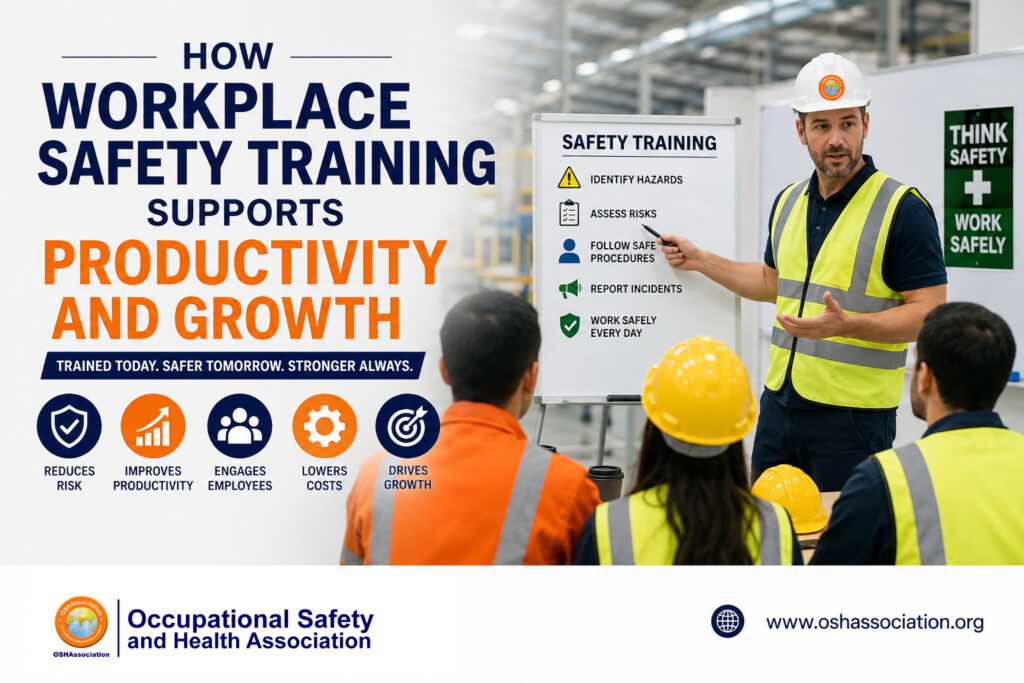
Many organisations view workplace safety training as a legal requirement or simply a compliance exercise. However, forward-thinking businesses understand that effective safety training is far more than meeting regulatory obligations—it is a strategic investment that directly contributes to productivity, employee wellbeing, and sustainable business growth.
A workforce that understands workplace hazards and follows safe working practices is more confident, efficient, and capable of maintaining consistent operational performance. Employees who receive appropriate training are better equipped to recognise risks, make informed decisions, and contribute to a safer and more productive working environment.
At OSHAssociation, we believe that investing in people through quality occupational safety and health training is one of the most valuable decisions any organisation can make.
Why Workplace Safety Training Matters
Workplace safety training equips employees with the knowledge, skills, and confidence to perform their duties safely while reducing workplace risks.
Effective training helps employees understand:
- Workplace hazards and how to control them
- Safe systems of work
- Emergency procedures and evacuation plans
- The correct use of Personal Protective Equipment (PPE)
- Incident reporting procedures
- Risk assessment principles
- Safe manual handling techniques
- Fire safety awareness
- Individual health and safety responsibilities
When employees understand both workplace hazards and the measures required to control them, they are better prepared to make safe decisions every day.
How Safety Training Improves Productivity
Many people assume that safety procedures slow down work. In reality, organisations with strong safety cultures often outperform those that treat health and safety as an afterthought.
The reasons are clear.
1. Fewer Workplace Accidents Mean Less Downtime
Every workplace accident has consequences that extend far beyond the individual involved. Even minor incidents can interrupt operations, delay projects, and reduce overall efficiency.
An incident may result in:
- Production delays
- Equipment damage
- Employee absence
- Investigation time
- Operational disruption
- Reduced team morale
Comprehensive workplace safety training significantly reduces the likelihood of accidents, allowing work to continue with fewer interruptions and greater efficiency.
2. Employees Work More Confidently
Confidence plays an important role in workplace productivity.
When employees understand how to use equipment correctly, identify hazards, respond appropriately to emergencies, and protect themselves and others, they carry out their duties with greater confidence and efficiency.
Confident employees make better decisions, work more independently, and contribute to smoother day-to-day operations.
3. Better Safety Leads to Higher Employee Engagement
Employees are more likely to remain engaged when they know their employer genuinely values their health and wellbeing.
Organisations that invest in regular workplace safety training demonstrate a clear commitment to protecting their workforce.
This helps create:
- Higher job satisfaction
- Greater employee loyalty
- Improved teamwork
- Better communication
- Stronger workplace morale
Engaged employees are typically more motivated, productive, and committed to organisational success.
4. Reduced Costs Improve Business Performance
Workplace injuries can have significant financial consequences for any organisation.
Costs may include:
- Medical expenses
- Compensation claims
- Equipment repairs
- Legal costs
- Regulatory penalties
- Increased insurance premiums
- Recruitment and training of replacement staff
By reducing accidents through effective safety training, organisations can minimise unnecessary costs and redirect resources towards innovation, growth, and employee development.
5. Improved Quality of Work
Safe working practices encourage employees to follow established procedures consistently and correctly.
As a result:
- Fewer mistakes occur.
- Product quality improves.
- Equipment lasts longer.
- Rework is reduced.
- Customer satisfaction increases.
Quality and safety are closely linked because both depend on consistency, competence, and adherence to established procedures.
6. Supports Legal Compliance
Employers have a legal duty in many industries to provide suitable health and safety training for their employees.
Well-trained employees help organisations remain compliant by:
- Following safe systems of work
- Using equipment correctly
- Reporting hazards promptly
- Maintaining accurate records
- Supporting workplace inspections and audits
Maintaining compliance reduces the risk of enforcement action, legal disputes, and reputational damage.
7. Builds a Positive Safety Culture
Safety training is about much more than learning procedures—it helps shape attitudes, behaviours, and workplace values.
When everyone understands that safety is a shared responsibility, organisations develop a positive safety culture where employees:
- Look out for one another
- Report hazards confidently
- Suggest safety improvements
- Follow procedures consistently
- Participate in continuous learning
A strong safety culture contributes to safer workplaces, improved morale, and long-term organisational success.
Workplace Safety Training Is an Investment, Not an Expense
Some organisations hesitate to invest in ongoing safety training because they see it as an additional expense.
In reality, the cost of inadequate training is often far greater.
Without appropriate training, organisations are more likely to experience:
- Workplace injuries
- Increased absenteeism
- Reduced productivity
- Higher insurance costs
- Equipment damage
- Legal liabilities
- Loss of customer confidence
Investing in employee competence delivers long-term returns through improved performance, reduced risk, and sustainable business growth.
Best Practice for Effective Workplace Safety Training
To maximise the benefits of workplace safety training, organisations should:
- Provide comprehensive induction safety training for all new employees.
- Deliver refresher training regularly.
- Tailor training to specific job roles and workplace hazards.
- Include practical demonstrations and realistic workplace scenarios.
- Encourage employee participation and discussion.
- Assess the effectiveness of training through observations and evaluations.
- Update training whenever new equipment, processes, or workplace risks are introduced.
Continuous learning helps ensure that employees remain competent, confident, and prepared to work safely.
The Role of Leadership
Leadership plays a critical role in creating a successful workplace safety culture.
Managers and supervisors should:
- Lead by example.
- Participate in workplace safety training.
- Reinforce safe behaviours every day.
- Recognise employees who demonstrate good safety practices.
- Provide the resources employees need to work safely.
When leaders prioritise health and safety, employees are far more likely to adopt the same approach.
How OSHAssociation Helps Build Safer and More Productive Workplaces
At OSHAssociation, we are committed to helping individuals and organisations develop the knowledge, skills, and confidence needed to create safer workplaces worldwide.
We support continuous professional development through:
- Internationally recognised occupational safety and health certification programmes
- Professional membership opportunities
- Workplace safety education, guidance and awareness resources
- Training delivered through our network of Authorised Training Providers (ATPs)
- Resources that help organisations strengthen their safety culture and improve operational performance
Whether you are an employer seeking to improve workplace safety or a professional looking to advance your career, investing in quality occupational safety education is an investment in long-term success.
Final Thoughts
Workplace safety training is far more than a compliance requirement—it is a powerful driver of productivity, operational efficiency, employee confidence, and sustainable business growth.
Organisations that invest in continuous safety education experience fewer workplace accidents, higher employee engagement, improved quality, and greater resilience in an increasingly competitive environment.
A safer workplace is a more productive workplace. By investing in continuous workplace safety training, organisations create healthier working environments, improve operational performance, and position themselves for sustainable long-term growth.
If your organisation is committed to building a stronger safety culture or advancing professional competence in occupational safety and health, visit www.oshassociation.org to explore our internationally recognised certification programmes, professional membership opportunities, workplace safety resources, and latest articles.
Together, we can promote safer workplaces, empower safety professionals, and save lives.