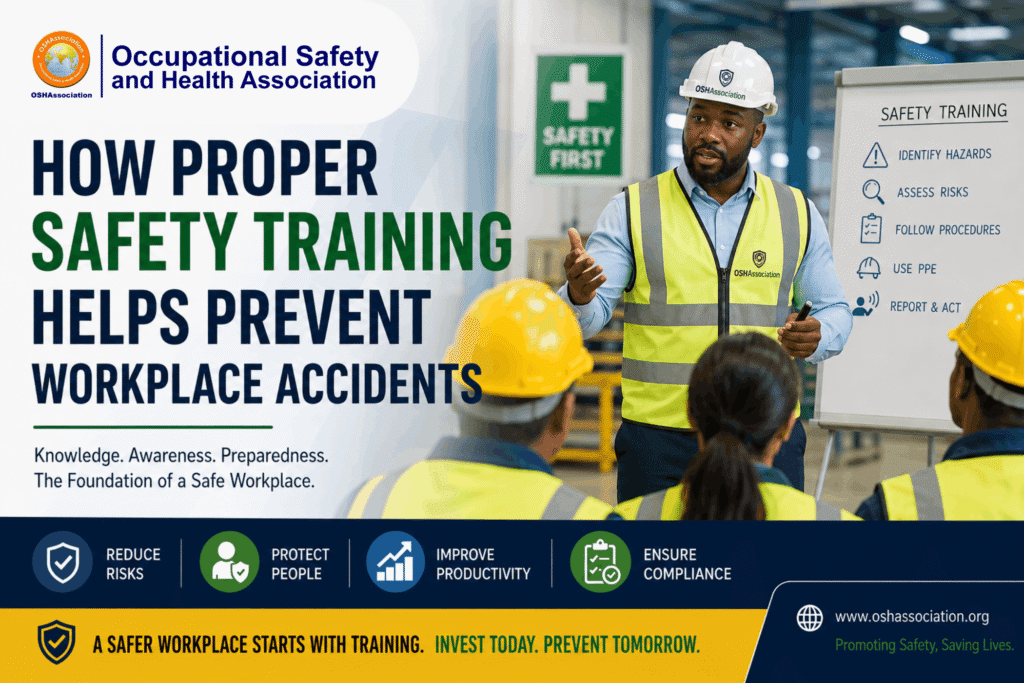
Workplace accidents rarely happen without warning. In many cases, incidents occur because employees are not adequately trained, hazards are not properly understood, or safe procedures are not consistently followed.
Proper safety training plays a vital role in helping organisations identify risks, prevent unsafe behaviour, and prepare employees to respond appropriately to workplace hazards. It is not simply a regulatory requirement—it is an essential investment in people, productivity, and the future of an organisation.
What Is Proper Safety Training?
Proper safety training goes beyond giving employees a handbook or asking them to watch a short induction video.
Effective training should help employees understand:
- The hazards associated with their work
- How to identify unsafe conditions
- The correct procedures for performing tasks safely
- How to use equipment and personal protective equipment (PPE)
- What to do during an emergency
- How to report hazards, incidents, and near misses
Most importantly, training should be relevant to the actual work employees perform.
A worker who understands the risks associated with their job is better equipped to make safer decisions.
1. Training Helps Employees Recognise Workplace Hazards
One of the most important benefits of safety training is improved hazard awareness.
Workplace hazards can include:
- Slips, trips, and falls
- Moving machinery
- Electrical hazards
- Hazardous substances
- Manual handling activities
- Working at height
- Fire risks
- Poor workplace conditions
Without appropriate training, employees may fail to recognise a hazard until an accident occurs.
Proper training teaches workers to identify potential dangers before they cause harm. This allows hazards to be reported and controlled before they become incidents.
2. Training Promotes Safe Working Practices
Employees may know that a task is dangerous, but they may not always know the safest way to perform it.
Safety training provides employees with the knowledge and skills needed to carry out their duties safely.
This may include learning how to:
- Operate equipment correctly
- Follow safe systems of work
- Use PPE properly
- Handle hazardous substances
- Lift and move materials safely
- Work safely at height
- Respond to emergency situations
When safe procedures are clearly understood and consistently applied, the likelihood of accidents is significantly reduced.
3. Training Reduces Unsafe Behaviour
Human behaviour is often a contributing factor in workplace incidents.
Employees may take shortcuts because:
- They are under pressure to complete work quickly.
- They do not understand the risks involved.
- They have not received adequate training.
- They believe an unsafe practice is normal.
- They have not been properly supervised.
Effective safety training helps employees understand not only what they should do, but also why safe procedures matter.
When workers understand the possible consequences of unsafe actions, they are more likely to make responsible decisions.
4. Training Improves Emergency Preparedness
Even with strong preventive measures, emergencies can still occur.
Employees need to know what to do in situations such as:
- Fire
- Serious injury
- Chemical spills
- Equipment failure
- Evacuation
- Workplace violence
- Other emergency situations
Training helps employees respond calmly and appropriately when an emergency occurs.
A workforce that knows how to raise an alarm, evacuate safely, report an incident, or provide appropriate initial assistance can help reduce the impact of an emergency.
5. Training Encourages Reporting and Communication
A strong safety culture depends on effective communication.
Properly trained employees are more likely to understand the importance of reporting:
- Hazards
- Near misses
- Unsafe conditions
- Unsafe behaviours
- Injuries and incidents
Near misses are particularly important because they can provide valuable lessons. A near miss is a warning that something went wrong but did not result in injury or damage.
When organisations learn from near misses, they have an opportunity to correct problems before a more serious accident occurs.
6. Training Supports a Stronger Safety Culture
Safety training should not be treated as a one-time activity.
A strong safety culture is built through continuous learning and reinforcement.
Organisations should consider:
- Induction training for new employees
- Refresher training
- Toolbox talks
- Task-specific training
- Emergency drills
- Regular safety communication
- Ongoing professional development
When safety is consistently discussed and reinforced, it becomes part of the organisation’s everyday culture.
Why Choosing the Right Training Matters
Not all training provides the same level of value.
Quality safety training should be:
Relevant
Training should address the actual hazards and responsibilities associated with the learner’s role.
Competence-Based
Learners should gain practical knowledge and understanding that can be applied in the workplace.
Properly Assessed
Assessment helps determine whether learners have understood the course content and achieved the required level of competence.
Delivered Through a Recognised Training Provider
The quality of training depends significantly on the organisation delivering it. Choosing a recognised and properly authorised training provider gives learners and employers greater confidence in the training process.
Building a Safer Future Through Professional Certification
At the Occupational Safety and Health Association (OSHAssociation), we believe that quality education and professional development are essential to improving workplace safety worldwide.
OSHAssociation is an international professional membership and certification organisation dedicated to promoting safety across all industries.
We work with OSHAssociation Authorised Training Providers around the world. These training organisations are accredited and authorised by OSHAssociation to deliver approved health and safety training programmes. Upon successful completion of the required training and assessment, eligible learners may receive OSHAssociation certification.
This model helps connect learners with approved training opportunities while supporting the development of competent safety professionals across different industries and countries.
Are You Looking to Advance Your Safety Career?
Whether you are beginning your career in occupational health and safety, seeking to develop your professional knowledge, or looking for internationally recognised certification, choosing the right training pathway is an important step.
Through its network of Authorised Training Providers, OSHAssociation provides opportunities for individuals to access approved safety training and pursue professional certification.
Organisations and training institutions interested in joining our global network can also explore opportunities to become an OSHAssociation Authorised Training Provider.
Learn More About OSHAssociation
Visit www.oshassociation.org to:
- Explore OSHAssociation certification opportunities.
- Find information about Authorised Training Providers.
- Learn about professional membership.
- Explore safety education and professional development opportunities.
- Access health and safety resources and articles.
- Discover opportunities to partner with OSHAssociation.
A safer workplace begins with knowledge. Proper training gives people the knowledge, skills, and confidence to recognise hazards, make safer decisions, and help prevent workplace accidents.
Invest in knowledge. Build competence. Promote safety.
OSHAssociation
Promoting Safety, Saving Lives.